
Government Shutdowns and You (and Me)
What are government shutdowns? Why do they happen? How can they affect you in real time?

Hello readers,
We have decided that our Wednesday Reader informational articles will be in response to your ideas. The primary purpose of this newsletter is to keep you informed, and we want to give you a platform to hopefully have some of your questions answered.
Every Monday or Tuesday, we will post a thread in our subscriber chat (which is available to all subscribers) asking what you’d like to know about.
This week, thanks to a recommendation from Susan Sciarratta, we are going to tell you about government shutdowns and the Congressional budget process. This topic is relevant, as the House of Representatives is currently negotiating a C.R., or “continuing resolution,” which would extend federal funding of various programs into March of 2025. With a looming current deadline of December 20th (which was already an extension from late September), a government shutdown is possible.
Before we can fully describe the nature and characteristics of government shutdowns, however, you need to have a basic understanding of how the Congressional budget appropriations process works.

Congressional Budget Process
Per the Constitution and its concept of “separation of powers,” the Senate and House of Representatives are tasked with determining the level of funding appropriate for various federal programs and agencies in what is called an “appropriations bill” [1,2]. Here is a very short version on how this happens:
The President sends their administration’s budget proposal to Congress [2].
From this, the budget committees in both chambers of Congress create budget resolutions to present to their respective colleagues in the House and Senate [2].
These resolutions contain what is called a 302(a) allocation, or the amount of money the 12 appropriations committees are given to use in their negotiations, and once they are approved in the Senate and House, the committees can begin appropriating money to the various agencies and programs that fall under their jurisdiction. I won’t list them all, but some of the appropriations committees include 1.) agriculture, 2.) defense, 3.) energy and water, and 4.) labor, HHS, and education. The amount of money assigned to each committee greatly depends on what it is responsible for funding [2].
Let’s pretend that this goes smoothly (it never does), and both chambers agree on the appropriations bill with zero complaints.
The bill gets sent to the President for signature. Considering the White House has no issues with the bill and the President signs, the new fiscal year begins with the funds appropriated.

What happens when one or both Chamber of Congress can’t agree on some or all of the appropriations in the appropriations bill? What if it is not signed into law before the deadline (usually late September, sometimes early October) because the President takes issue with something? If no preventative action is taken, such as a continuing resolution (a resolution that temporarily extends the current fiscal year for a few months), a government shutdown happens.
What is a government shutdown?
By definition, a government shutdown in the United States is when funding legislation, called an appropriations bill, is not signed into law before the next fiscal year starts [1]. There are two types of government shutdowns, though neither can be clearly defined:
Partial government shutdowns, during which some of the appropriations, or budget items, are approved and some federal agencies and programs are funded and continue to function [1,3]. An example of this would be the three day shutdown during Donald Trump’s first term, from January 20, 2018 to January 23, 2018, when some agencies continued to operate, such as the EPA and the Department of Energy, and only a third of National Parks were closed [1,8].
Full government shutdowns, during which few to none of the appropriations are passed and many federal agencies and programs drastically reduce or halt operations [1,3]. An example of this would be the second shutdown of Donald Trump’s first term, from December 22, 2018 to January 25, 2019, when government agencies and programs were heavily affected for 35 days [1,9]. During this time, over 380,000 federal workers were furloughed (temporary laid off without a return date) and over 420,000 more had to work with no pay and with no known future pay date (including members of the armed forces) [1]. National Parks closed, some airports ceased operations due to a shortage of TSA agents, the IRS was delayed in processing over $100 billion in tax returns, food stamps were cut, and much, much more [1,9]. The deadlock was over Republicans’ demand for a border wall provision to be added to the appropriations bill (at the behest of President Trump), and it eventually ended because a lot of air traffic controllers weren’t showing up to work [1,9].
Shutdowns are relatively frequent, at least in recent history. As mentioned above, there were two shutdowns during Trump’s first term in office (2018 and 2018-2019), both over immigration issues [1,8,9]. Before that, there was a full government shutdown in 2013 during Obama’s second term in office, this time over a few measures Senate Republicans were trying to add to the appropriations bill for fiscal year 2014, measures that would delay funding for the Affordable Care Act [6]. Obama and Senate Democrats balked, and a 16-day shutdown ensued. During this shutdown over 800,000 federal workers were furloughed, with an additional 1.3 million required to work without a known pay date [1,6]. As with the 2018-2019 shutdown, many government programs and agencies were severely reduced in operations and affectivity.
Using these examples, what can happen during a shutdown in the United States Government?
Federal workers may be furloughed.
Federal workers may be required to work for no pay, without knowing when they will be paid. This applies to members of the military, federal law enforcement officers, medical workers who work in federal facilities, air traffic controllers, and more [1].
National Parks and other federally run attractions may close, costing tourist revenue.
Social benefit programs like SNAP (food stamps) can be drastically reduced. This was especially seen during the shutdown of 2018-2019 [7].
Operations of major government agencies, such as the IRS and FBI, can be heavily affected.
Potentially, many more things. If it’s a program or agency funded by Congress, there is a good chance it will be affected.
What continues to function normally, if anything?
Congress still gets paid. This can only be changed by direct law [1].
The US Postal Service is not affected as it is self funded.
As said above, some essential workers have to report (active-duty military, some medical professionals, law enforcement, etc)
Some offices will stay open, operating on reserve funding for as long as possible.
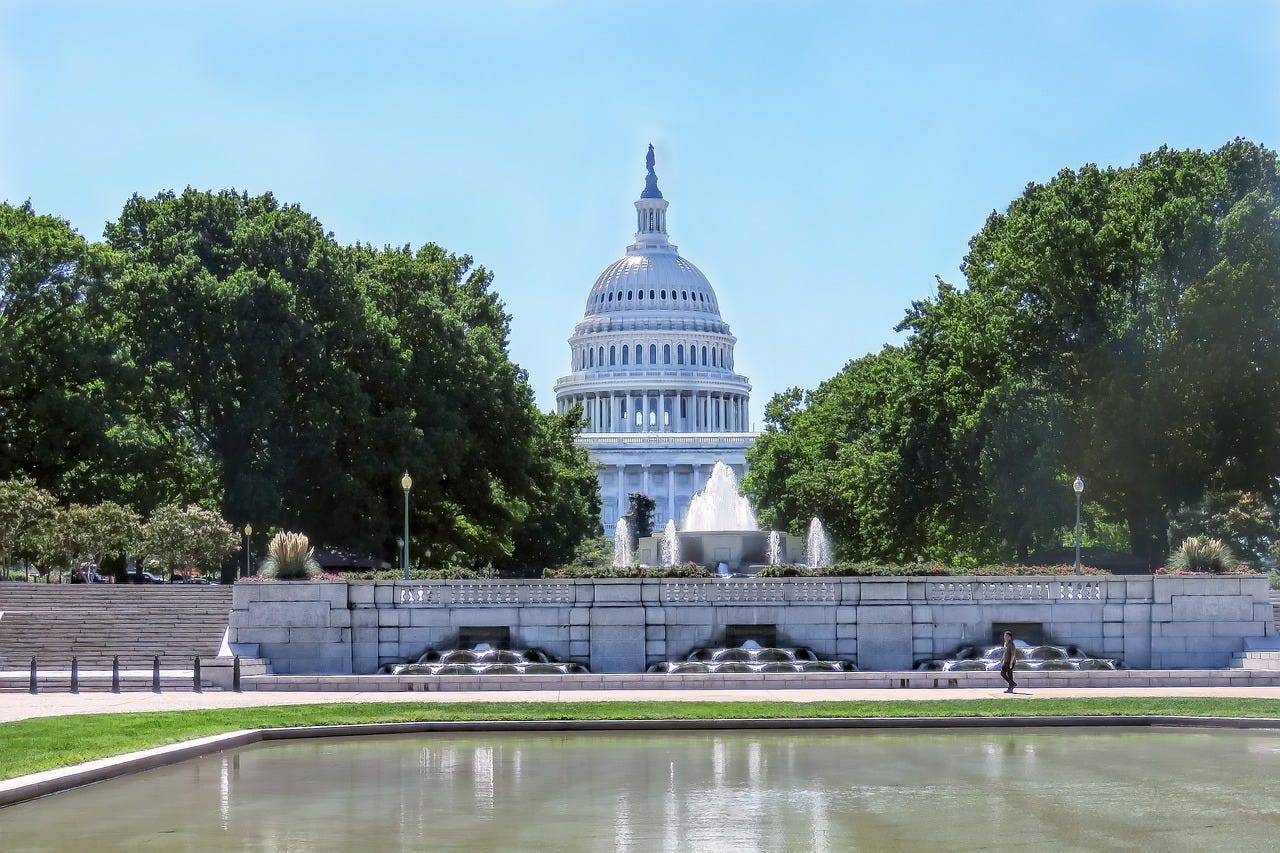
What is going on now in Congress? Is the government going to shut down?
Probably not, but maybe. Yesterday, leading House Republicans finally revealed their continuing resolution, or CR, for next year’s appropriations bill; like we said at the beginning of this article, this will only extend the final deadline until March of 2025. The current deadline is this Friday, December 20th, and this was already extended via another continuing resolution from September [3,4].
To clarify directly, a continuing resolution is a piece of “stopgap” legislation that prevents the government from shutting down by extending the budget year. This is not the new budget being enacted, but is essentially Congress buying more time to hash out the actual appropriations bill for the next fiscal period [3,5].
The text for this week’s continuing resolution had been promised by Sunday, December 15, but was a little late, largely due to Republican infighting [3,5]. Speaker Johnson recently presented the spending plan at a House Republican conference to mediocre reviews, Rep. Eric Burlison (R-MI) calling it a “total dumpster fire” and Rep. Chip Roy (R-TX) saying “this is not the way to do business right” [4,5]. Roy also noted that “we get this negotiated crap, and we’re forced to eat this crap sandwich” [5]. In this context, crap sandwich probably refers to the continuing resolution.
Many House Republicans were frustrated that Johnson was negotiating with Democrats, and at one point during the conference, Rep. Mike Lawler (R-NY) told Johnson: “I’m not a fucking Democrat” [5].

On the CR itself, Speaker Mike Johnson (R-LA) said…
This is a small CR that we’ve had to add things to that were out of our control. These were not man-made disasters, these were things that the federal government has an appropriate role to do. I wish it weren’t necessary. I wish we didn’t have record hurricanes in the fall. I wish farmers were not in a bind such that creditors are not able to lend to them anymore. We have to be able to help those who are in these dire straits, and that’s what the volume of the pages to this is.
Johnson is referencing the significant amount of federal aid appropriated to disaster relief in the continuing resolution, around $113 billion dollars; $29 billion of this will go to FEMA, $21 billion to help farmers who had crop and livestock losses, $12 billion to help communities recover through various grants, $8 billion to repair roads, $2.2 billion in low-interest loans for small businesses trying to rebuild after disasters, and a lot more [3]. An additional $10 billion was approved to help farmers facing financial issues due to commodity prices and other challenges presented by the marketplace (unrelated to disasters) [3,4,5].
Also in the bill are provisions restricting investment in Chinese companies (or any country that could be a national security threat), expanding Medicare coverage for Telehealth appointments, allocating funds to rebuild the Francis Scott Key Bridge in Baltimore, and transferring land where the old RFK stadium stood to the District of Columbia (possibly for the site of a new Washington Commanders stadium) [3,5].
Will this continuing resolution pass this week? Let’s hope. The vote should happen by Thursday.
Thank you.
If you have made it this far, thank you!
Have any questions? Send us a message!
We are a subscriber supported publication, so if you’d like to show us some totally optional but greatly appreciated support, you can now become a paid subscriber. No pressure!
You can also buy us a coffee here.
Our next article, The Capitol Hill Reader Volume VI, will be released this Saturday.
Works Cited
1.)https://en.wikipedia.org/wiki/Government_shutdowns_in_the_United_States
2.) https://www.crfb.org/papers/appropriations-101#totallevel
3.) https://apnews.com/article/congress-budget-government-shutdown-farmers-disaster-relief-4c6ae1e0033637bb6398b00c4799ba0d
4.) https://www.washingtonpost.com/business/2024/12/17/government-shutdown-baltimore-bridge-farms/
5.) https://www.wjtv.com/hill-politics/house-republicans-fume-at-speaker-johnson-over-handling-of-cr-a-total-dumpster-fire/
6.) http://www.washingtontimes.com/news/2013/sep/20/house-passes-spending-bill-defund-obamacare/
7.) https://www.cbsnews.com/news/government-shutdown-affect-snap-food-stamps-wic-millions-could-face-severe-cuts-in-2019-funding-usda-2018-01-09/
8.) https://www.foxnews.com/politics/government-braces-for-shutdown-as-senate-fails-to-meet-deadline-for-spending-deal.amp
9.) https://www.bbc.co.uk/news/world-us-canada-47007081
Thanks for your work. I found this article to be extremely helpful as we navigate these uncertain and difficult times. Does anyone actually read the CR? I’ve heard it’s over 1500 pages long ?!
I suspect changing the law to say that Congress doesn't get paid during shutdowns would alleviate the annual or semi-annual shut down "emergencies". Also, furloughed workers who did not show up for work should not continue to receive back pay after a new budget (or more likely another CR) is signed. Again, if support staff didn't know they could get back pay (ie. a free vacation) every time we have another budget "emergency", I suspect those workers and their unions would have some influence on Congress to focus on negotiating a budget before a shutdown is looming. This is one of Congress' primary functions and they act like middle school procrastinators who try to write their term papers on the bus in the morning of the day it's due.