
The Capitol Hill Reader 130: Governing by Memo, Order, and Footnote
Your weekly sampler of delicious government tea

Hello readers,
This week’s digest is short and busy, with a small number of nevertheless highly consequential government actions coming from the White House, the Courts, and Congress.
This includes, but is not limited to…
A sweeping Trump executive order on seized Venezuelan funds
A flurry of administration-backed messaging pieces on immigration, ICE, law enforcement, and dietary guidelines
A major presidential memorandum withdrawing the United States from dozens of international organizations and treaties, including climate, energy, development, and multiple United Nations bodies.
Congressional action across both chambers, from a bipartisan Senate effort to limit unauthorized military action against Venezuela to House votes on an omnibus package, veto overrides, and a large FY2026 appropriations bill.
The Supreme Court’s decision in Bowe v. United States and a paid deep dive into Jack Smith’s closed-door testimony, touching on January 6, classified documents, and the mechanics of prosecuting a former president.
Jack Smith’s latest testimony, summarized
When we typed the number 130 for this issue, we realized a few things. A) how crazy it is we’ve written 130 of these digests and B.) that many of you have been consistently supporting us in whatever ways you can!
If you like what you read in today’s digest, consider sticking around as a subscriber! To bring in the New Year, you can support us for $25 a year by using the link below. You can also buy us a cup of coffee here (though you will be enabling our addictions).

If you already are a paid supporter, scroll to the bottom of this issue for an exclusive section regarding Jack Smith’s latest testimony given on December 17, 2025. We figured the best way to consistently say thank you is to add a little something extra on each digest rather than trying to fit another article in during the week, so enjoy!
The Actions of the President
January 9, 2026
Executive Order - SAFEGUARDING VENEZUELAN OIL REVENUE FOR THE GOOD OF THE AMERICAN AND VENEZUELAN PEOPLE
This executive order declares a national emergency under IEEPA and the NEA to shield recently seized Venezuelan funds held in U.S. Treasury accounts from any type of legal action and/or seizure, asserting that this would “undermine U.S. national security and foreign policy interests.” It bars courts and private creditors from placing liens, enforcing judgments, or otherwise interfering with the funds in any way, and restricts any transfer or use of the money unless explicitly authorized by the United States government. The order states that the funds remain the sovereign property of Venezuela and are held by the United States strictly in a custodial, noncommercial capacity, while at the same time directing Treasury and Justice Department officials to “assert sovereign immunity” and manage the assets in coordination with the State Department.
Like many Trumpian executive orders, it’s written as broadly as possible. When it prohibits “any attachment, judgment, decree, lien, execution, garnishment, or other judicial process,” it is intentionally covering all judicial actions, whether they originate in state courts, U.S. federal courts, or any other tribunal that might attempt to seize the funds.
Under this executive order is a fact sheet claiming that U.S. control over the money is essential in combatting “malign actors like Iran and Hezbollah” and “stemming the influx of illegal aliens and disrupt[ing] the flow of illicit narcotics” into the U.S.
Article - 57 Times Sick, Unhinged Democrats Declared War on Law Enforcement
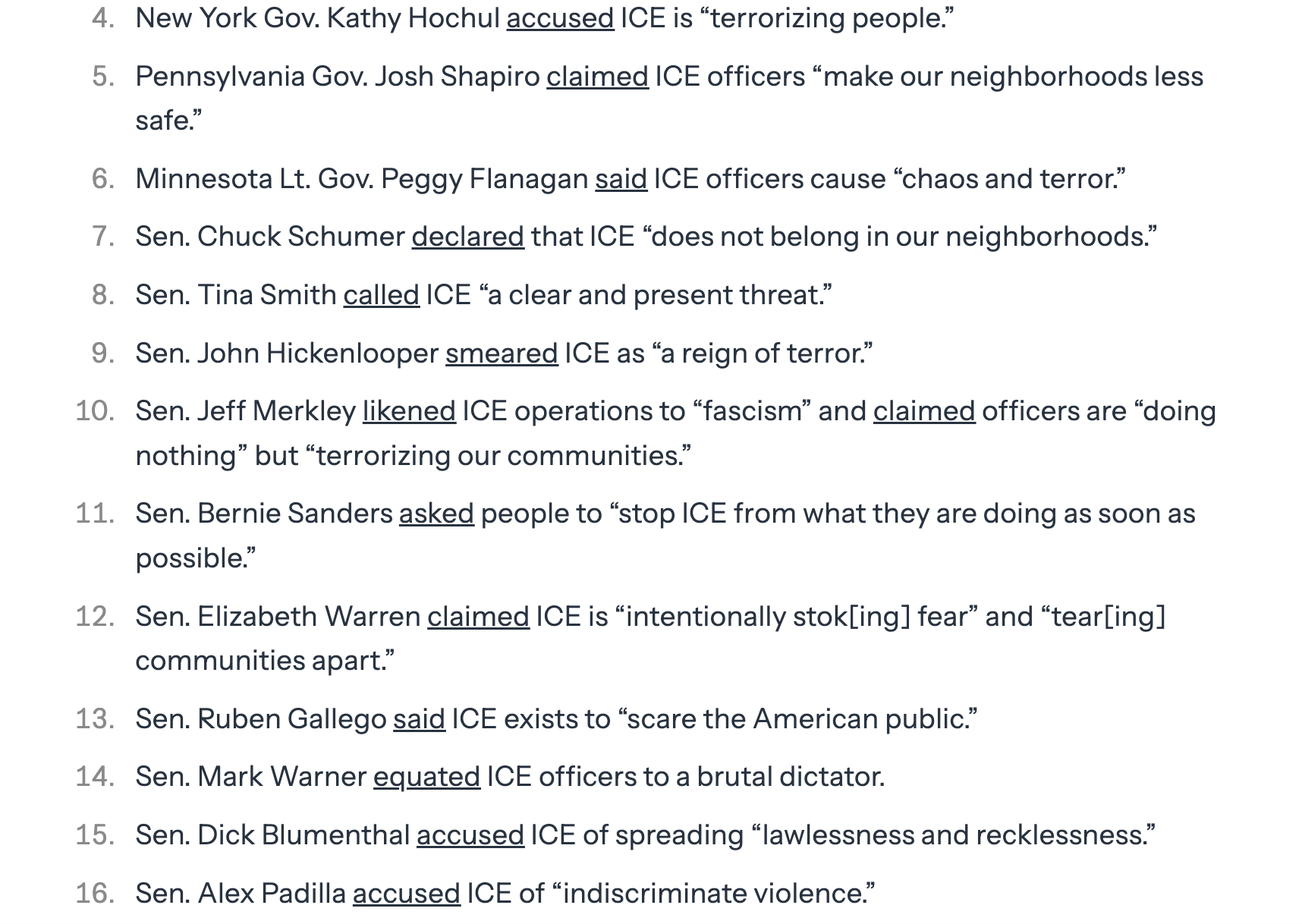
This is a list of 57 things various Democratic lawmakers have said about ICE’s activities. It starts with:
On National Law Enforcement Appreciation Day, the Trump Administration proudly honors the brave patriots of ICE and all law enforcement who put their lives on the line to protect America. In stark contrast, unhinged Radical Left Democrats have escalated their torrent of vicious, inflammatory attacks on these very heroes — branding them as Nazis, terrorists, and Gestapo thugs while inciting their delusional supporters to unleash violence.
Check it out here. We’ve attached a sample screenshot below.
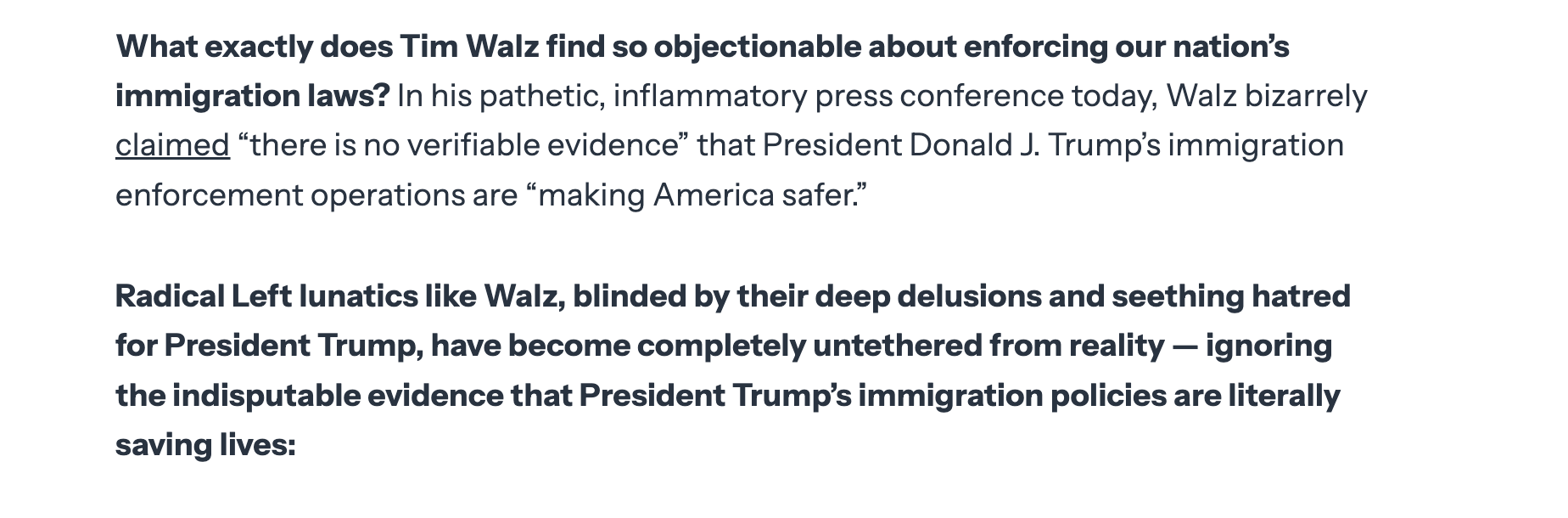
Article - Walz Is Wrong: President Trump’s Immigration Policies Are Saving Lives
This is an article essentially talking smack about Minnesota Governor Tim Waltz, as well as listing some law enforcement statistics. Here’s a screen shot.
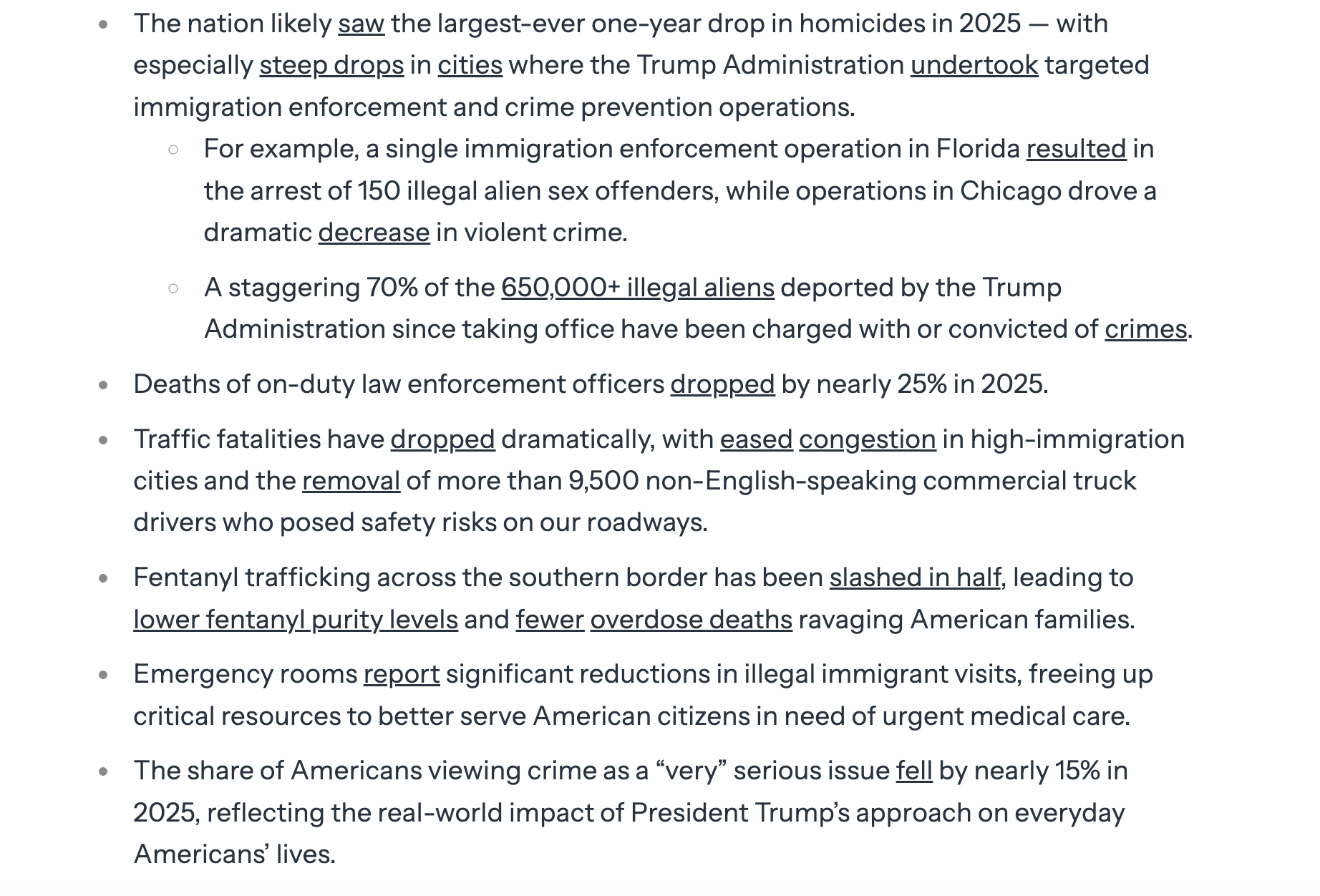
The links are to various social media posts, DHH press releases, and a few news articles.
January 8, 2026
Article - WHAT THEY ARE SAYING: Trump Administration Puts Real Food First in Dietary Guidelines
This is a list of quotes from “leading medical organizations, farmers, public health experts, and wellness advocates alike” about Trump’s healthy food initiatives, such as the one below.

January 7, 2026
Memorandum - Withdrawing the United States from International Organizations, Conventions, and Treaties that Are Contrary to the Interests of the United States
This is a long list of “organizations, conventions, and treaties” that the United States is no longer party to because they are “contrary to the interests of the United States.” Per a fact sheet, many of these organizations “promote radical climate policies, global governance, and ideological programs that conflict with U.S. sovereignty and economic strength,” and that the U.S. has “spent billions” on them with “little return.”
Sec. 2. Organizations from Which the United States Shall Withdraw. (a) Non-United Nations Organizations:
(i) 24/7 Carbon-Free Energy Compact;
(ii) Colombo Plan Council;
(iii) Commission for Environmental Cooperation;
(iv) Education Cannot Wait;
(v) European Centre of Excellence for Countering Hybrid Threats;
(vi) Forum of European National Highway Research Laboratories;
(vii) Freedom Online Coalition;
(viii) Global Community Engagement and Resilience Fund;
(ix) Global Counterterrorism Forum;
(x) Global Forum on Cyber Expertise;
(xi) Global Forum on Migration and Development;
(xii) Inter-American Institute for Global Change Research;
(xiii) Intergovernmental Forum on Mining, Minerals, Metals, and Sustainable Development;
(xiv) Intergovernmental Panel on Climate Change;
(xv) Intergovernmental Science-Policy Platform on Biodiversity and Ecosystem Services;
(xvi) International Centre for the Study of the Preservation and Restoration of Cultural Property;
(xvii) International Cotton Advisory Committee;
(xviii) International Development Law Organization;
(xix) International Energy Forum;
(xx) International Federation of Arts Councils and Culture Agencies;
(xxi) International Institute for Democracy and Electoral Assistance;
(xxii) International Institute for Justice and the Rule of Law;
(xxiii) International Lead and Zinc Study Group;
(xxiv) International Renewable Energy Agency;
(xxv) International Solar Alliance;
(xxvi) International Tropical Timber Organization;
(xxvii) International Union for Conservation of Nature;
(xxviii) Pan American Institute of Geography and History;
(xxix) Partnership for Atlantic Cooperation;
(xxx) Regional Cooperation Agreement on Combatting Piracy and Armed Robbery against Ships in Asia;
(xxxi) Regional Cooperation Council;
(xxxii) Renewable Energy Policy Network for the 21st Century;
(xxxiii) Science and Technology Center in Ukraine;
(xxxiv) Secretariat of the Pacific Regional Environment Programme; and
(xxxv) Venice Commission of the Council of Europe.
(b) United Nations (UN) Organizations:
(i) Department of Economic and Social Affairs;
(ii) UN Economic and Social Council (ECOSOC) — Economic Commission for Africa;
(iii) ECOSOC — Economic Commission for Latin America and the Caribbean;
(iv) ECOSOC — Economic and Social Commission for Asia and the Pacific;
(v) ECOSOC — Economic and Social Commission for Western Asia;
(vi) International Law Commission;
(vii) International Residual Mechanism for Criminal Tribunals;
(viii) International Trade Centre;
(ix) Office of the Special Adviser on Africa;
(x) Office of the Special Representative of the Secretary General for Children in Armed Conflict;
(xi) Office of the Special Representative of the Secretary-General on Sexual Violence in Conflict;
(xii) Office of the Special Representative of the Secretary-General on Violence Against Children;
(xiii) Peacebuilding Commission;
(xiv) Peacebuilding Fund;
(xv) Permanent Forum on People of African Descent;
(xvi) UN Alliance of Civilizations;
(xvii) UN Collaborative Programme on Reducing Emissions from Deforestation and Forest Degradation in Developing Countries;
(xviii) UN Conference on Trade and Development;
(xix) UN Democracy Fund;
(xx) UN Energy;
(xxi) UN Entity for Gender Equality and the Empowerment of Women;
(xxii) UN Framework Convention on Climate Change;
(xxiii) UN Human Settlements Programme;
(xxiv) UN Institute for Training and Research;
(xxv) UN Oceans;
(xxvi) UN Population Fund;
(xxvii) UN Register of Conventional Arms;
(xxviii) UN System Chief Executives Board for Coordination;
(xxix) UN System Staff College;
(xxx) UN Water; and
(xxxi) UN University.
Executive Order - PRIORITIZING THE WARFIGHTER IN DEFENSE CONTRACTING
This executive order argues that U.S. defense contractors have focused too heavily on profits and shareholder payouts at the expense of producing weapons and equipment quickly and reliably for the military. It states that while the United States makes high-quality military hardware, production is too slow to meet current security needs, and many contractors continue to pursue stock buybacks and dividends despite underperforming on existing contracts. As a result, the provision bars defense contractors from paying dividends or buying back stock until they can deliver superior products on time and within budget.
For example, Trump has recently threatened to cut all government funding for defense contractor Raytheon due to the aforementioned focus on stock buybacks and dividends for shareholders.
The Actions of Congress
The Senate
Notable Measures Considered
S.J.Res.98 - A joint resolution to direct the removal of United States Armed Forces from hostilities within or against Venezuela that have not been authorized by Congress.
This is a bipartisan Senate Joint Resolution attempting to prevent a direct military confrontation with Venezuela without the consent on Congress. It’s not necessarily saying that no action can be taken, but that, per federal law, these actions require a formal declaration of war or “other authorization” per Congressional review. This vote was to discharge the resolution from committee for later consideration on the floor.
The motion to discharge was AGREED TO on January 8, 2026 by a yea-and-nay vote of 52 YEAS to 47 NAYS, with 1 not voting. 5 Republicans voted with Democrats to pass the discharge.
Nomination Confirmations
On the nomination confirmation of Alexander C. Van Hook, of Louisiana, to be U.S. District Judge for the Western District of Louisiana
CONFIRMED on January 8, 2026, by a yea-and-nay vote of 53 YEAS to 40 NAYS, with 7 not voting.
On the nomination confirmation of Sara Bailey, of Texas, to be Director of National Drug Control Policy
CONFIRMED on January 6, 2026, by a yea-and-nay vote of 52 YEAS to 48 NAYS.
On the nomination confirmation of Joshua Simmons, of Virginia, to be General Counsel of the Central Intelligence Agency
CONFIRMED on January 6, 2026, by a yea-and-nay vote of 53 YEAS to 47 NAYS.
On the nomination confirmation of Keith Bass, of Texas, to be an Assistant Secretary of Defense
CONFIRMED on January 5, 2026, by a yea-and-nay vote of 50 YEAS to 35 NAYS, with 15 not voting.
The House of Representatives
Notable Measures Considered
H.R.5184 - To authorize the Secretary of Energy to transmit to the Secretary of Housing and Urban Development recommendations for changes to preemptive energy conservation standards applicable to manufactured homes
Per the Congressional Research Service, “This bill rescinds Department of Energy (DOE) energy efficiency regulations applicable to manufactured housing and eliminates DOE’s authority to issue similar regulations. Specifically, the bill rescinds the DOE final rule titled Energy Conservation Program: Energy Conservation Standards for Manufactured Housing and published on May 31, 2022.”
PASSED on January 9, 2026, by a yea-and-nay vote of 263 YEAS to 147 NAYS, with 21 not voting.
H.R.1834 - Breaking the Gridlock Act
This bill is a wide-ranging legislative package that stitches together dozens of largely noncontroversial policy items across Congress, ranging from creating a congressional time capsule for the nation’s 250th anniversary to tightening rules on fire suppression reimbursements, extending funding for the Udall Foundation, directing new strategies against Boko Haram, expanding veterans’ programs, restricting the sale of sensitive personal data to foreign adversaries, and requiring federal agencies to buy U.S.-made flags. It functions as an “omnibus vehicle” designed to move stalled or consensus-friendly provisions through the House by bundling them together. That said, given the vote tally it seems that Democrats did not agree on all of these being bipartisan issues.
PASSED on January 8, 2026, by a yea-and-nay vote of 230 YEAS to 196 NAYS, with 5 not voting.
H.R.131 - Finish the Arkansas Valley Conduit Act
This was a bipartisan piece of legislation that, “reduces payments that communities within the Arkansas River Valley must pay to the Bureau of Reclamation for the construction of the Arkansas Valley Conduit, a pipeline in Colorado for delivering water from the Pueblo Reservoir to such communities.” However, it was vetoed by the President on December 29, 2025; this vote was an attempt to bypass the veto via a 2/3 required vote in both Chambers of Congress.
This attempt FAILED on January 8, 2026, by a 2/3 required yea-and-nay vote of 248 YEAS to 177 NAYS, with 1 not present and 5 not voting. 35 Republicans voted with Democrats in this effort.
H.R.504 - Miccosukee Reserved Area Amendments Act
This bill “expanded the Miccosukee Reserved Area to include a portion of Everglades National Park in Florida that is known as Osceola Camp.” However, like the last bill, it was vetoed by Trump on December 29, 2025, and this vote was to try and bypass the veto.
This attempted FAILED on January 8, 2026, by a 2/3 required yea-and-nay vote of 236 YEAS to 188 NAYS, with 7 not voting. Like the last vote, this on was also bipartisan with 24 Republicans crossing the aisle.
H.R.6938 - Commerce, Justice, Science; Energy and Water Development; and Interior and Environment Appropriations Act, 2026
Per the CRS, “This bill provides FY2026 appropriations to several federal departments and agencies for activities and programs related to commerce, law enforcement, science, energy and water development, public lands, and the environment.”
PASSED on January 8, 2026, by a yea-and-nay vote of 397 YEAS to 28 NAYS, with 6 not voting.
The Supreme Court
BOWE v. UNITED STATES
In this case, Michael Bowe, who received a mandatory ten-year sentence for a 2008 firearm offense tied to attempted Hobbs Act robbery, argued that later Supreme Court decisions had undercut the legal basis for his original conviction, but procedural rules kept blocking his claims. Before the case came before the Supreme Court, a district court and the Eleventh Circuit had both ruled they lacked jurisdiction to review Bowe’s case whatsoever.
On January 9, 2026, the Supreme Court held that Congressional statutes apply the “old-claim” bar (of repeated petitioning or challenges) only to state habeas petitions, not federal ones, and that Congress did not clearly strip the Supreme Court of jurisdiction to review these federal cases. The Court vacated the Eleventh Circuit’s ruling and sent the case back for reconsideration under the correct standard; in other words, the Eleventh Circuit does have jurisdiction to review Bowe’s case, and now they must do so under the Court’s direction. This does not mean that Bowe will be exonerated, but his case will be reexamined.
Justice Gorsuch dissented, joined by Justices Thomas and Alito and in part by Justice Barrett, warning that the majority’s opinion opened the door to repeated post-conviction litigation by federal prisoners. The dissent argued that Congress intended the same strict limits on successive filings to apply across the board, and that today’s decision invites delay and uncertainty in criminal judgments. In their view, the Court replaced statutory discipline with judicial flexibility, undermining Congress’s effort to tightly control second chances in federal habeas review
Jack Smith’s Latest Testimony, Summarized
For this week’s paid section, we summarized Jack Smith’s latest testimony, given before the House Judiciary Committee in a closed-door session on December 17, 2025.
