
The Capitol Hill Reader 137: War Pigs, the Supreme Court, and Congressional Waffling.
Your weekly government sampler

Hello readers,
It was a relatively light week of official actions from the White House and Congress, so for that reason, we have combined the Focus and the Actions of the President sections into one Special Section on the developing situation in Iran.
We also have an in-depth analysis of Postal Service v. Conan, a Supreme Court decision holding that, even in situations in which a Postal Service employee knowingly and maliciously withholds someone’s mail, the victim likely can’t seek damages under the Federal Tort Claims Act.
Let’s get right to it.
Special Section — U.S. and Israeli Strikes on Iran
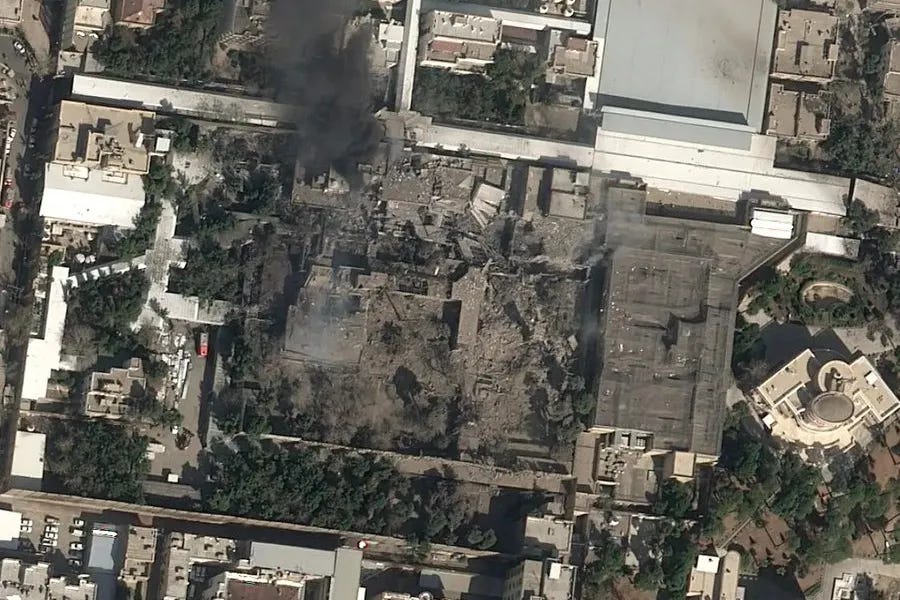
Early on February 28, 2026, coordinated military strikes by the United States and Israel hit multiple targets across Iran, including in Tehran and other cities. Both governments described these attacks as a campaign to neutralize “imminent” military and nuclear-related threats, while also pursuing a broader goal of destabilizing or replacing the current Iranian leadership.
In a video message posted the same day on Truth Social, Donald Trump said the United States had begun “major combat operations” to prevent Iran from obtaining a nuclear weapon and to destroy Iranian missile and naval capabilities.
In the same message, Trump appealed directly to Iranian security forces, including the Islamic Revolutionary Guard Corps, to lay down their weapons (offering “immunity” in some versions of the ultimatum), and encouraging the Iranian public to “take over” their government.
The offensive, described in various official and media accounts as “Operation Roaring Lion” (Israel) and “Operation Epic Fury” (United States), began with waves of air and missile strikes aimed at Iranian military infrastructure, leadership sites, missile forces, and other strategic assets. The Pentagon has described the U.S. operation as a multi-day effort, giving the impression of a sustained operation rather than a single strike package, and Trump told the Daily Mail that the war will take “four weeks or so.”
Casualties in Iran
Iranian state media confirmed the reported killing of Supreme Leader Ayatollah Ali Khamenei in the initial strikes, and Reuters also reported that Israeli and U.S. timing of the opening strikes was linked to intelligence about Khamenei’s movements and meeting schedule.
Civilian casualties have been severe. The Iranian Red Crescent Society reported (via Iranian media and as carried by international outlets) that across 24 provinces the strikes caused 201 deaths and 747 injuries as of February 28; these totals remain difficult to independently confirm in real time, though more information will come as the fog of war lifts.
Separately, the deadliest single reported incident remains the Israeli strike on a girls’ elementary school in Minab: Iran’s judiciary-linked Mizan outlet (as cited by The Guardian) reported 148 killed and 95 wounded, while Iranian state media reporting carried by Al Jazeera later reported 165 killed and 96 injured.
Iranian Reaction and Regional Spillover
Iran did not absorb the attacks passively. Within hours of the opening strikes, Iranian missiles and drones were launched not only toward Israel but also across the Gulf region, targeting states that host U.S. forces and contain regional infrastructure. By March 1, Reuters reported fatalities and damage in multiple countries and assessed the region’s airspace and travel sector as heavily disrupted, with multiple Gulf airports and urban centers under bombardment risk.
In Israel, casualty reporting also worsened. Early reporting cited six killed in a missile strike on Beit Shemesh; later reporting described nine killed there as Iranian barrages continued. Reuters also reported the United Arab Emirates saying Iranian attacks killed three people, with Kuwait reporting one dead.
Meanwhile, the escalation has taken on an economic warfare dimension: the Strait of Hormuz closed amid the strikes and retaliation, with shipping data showing hundreds of vessels (including oil and gas tankers) dropping anchor nearby as traders anticipated sharp oil-price moves.
Civilian Reactions Inside Iran
Among Iran’s civilian population, reactions seem divided. Numerous news outlets reported scenes of panic and flight, with families trying to get children from schools, residents preparing to leave cities, and people attempting to withdraw cash and stockpile essentials.
At the same time, both mourning and celebration can be seen after Khamenei’s death. Some footage showed mourners gathered in Tehran, while other social media videos showed open celebration and anti-regime defiance.

Here are some circulating social media videos of the strikes themselves, probably taken with phones. In them, you can hear what sounds like cheering and clapping:
https://x.com/i/status/2027676799468245405
https://x.com/i/status/2027720036362703155
https://twitter.com/i/status/2027717077276975136
Leadership succession and uncertainty inside the state
As Iran’s leadership absorbed the shock of Khamenei’s death, Iran initiated a constitutional succession process. Per reports, a temporary leadership council is assuming the supreme leader’s duties until a successor is chosen by the Assembly of Experts, and Reuters named the council members as President Masoud Pezeshkian, Chief Justice Gholamhossein Mohseni Ejei, and cleric Alireza Arafi as the jurist member. Al Jazeera separately summarized the same constitutional mechanism under Article 111, emphasizing the council’s interim role and the selection power of the Assembly of Experts.
International reactions
International reactions have reflected deep unease over the speed and scale of escalation. At an emergency meeting of the United Nations Security Council, António Guterres said the U.S. and Israeli airstrikes violated international law, including the U.N. Charter, while also condemning Iran’s retaliatory strikes for violating the sovereignty and territorial integrity of multiple states across the region.
If you’ve got some time, you can watch the Security Council meeting below:
Like what you’re reading? Your support leads to longer analyses, more frequent newsletters, and the ability to dedicate more time to bringing you accessible, summarized government information. Subscribe today for $2.50 a month or $25 a year!

The Road Ahead
The war with Iran is ongoing and updates can be found across numerous legacy and independent media outlets, so this will probably be our only update on the situation. That said, you will see elements of the conflict manifest themselves in Proclamations, Memoranda, and even Executive Orders from the White House that we report on, along with the inevitable symbolic resolutions in Congress that we will summarize for your reading pleasure. Strongly worded letters, that kind of thing. You know the drill.
The Supreme Court
The Supreme Court has been busy lately, readers. In today’s issue, we chose to write a deeper-than-usual analysis of a recent Supreme Court case called Postal Service v. Konan, which held that even in a situation where a Postal Service employee intentionally withholds your mail, you still (probably) can’t seek damages under the Federal Tort Claims Act.
Postal Service v. Konan
In this case, the Supreme Court held (5–4) that the United States retains sovereign immunity under the Federal Tort Claims Act (FTCA) for claims “arising out of the loss [or] miscarriage” of mail even when the plaintiff alleges that postal employees intentionally refused to deliver the mail or were acting maliciously. The Court reasoned that, as used in 1946, both “miscarriage” (mail failing to arrive properly) and “loss” (deprivation of mail) can occur through intentional nondelivery; therefore, the FTCA’s “postal exception,” 28 U.S.C. § 2680(b), bars suits seeking money damages on that theory.
Procedurally, the Court vacated the Fifth Circuit’s judgment (which had allowed Konan’s FTCA-based tort claims to proceed) and remanded for further proceedings. Importantly, the Court emphasized that it was not deciding whether all of Konan’s claims are barred by § 2680(b) or which arguments were properly preserved—leaving the lower courts to apply the Court’s interpretation to the particular pleadings and issues on remand.
Doctrinally, the decision strengthens the government’s immunity position in a recurring category of litigation: claims grounded in nondelivery, delay, or mishandling of mail (including alleged willful misconduct) framed as state-law torts and brought via the FTCA. Practically, it narrows a potential accountability pathway for deliberate mail withholding and shifts pressure toward administrative or legislative solutions rather than tort damages actions under the FTCA.
Case background and lower court opinions
The dispute arose in Euless, Texas, where Konan (who owned two nearby rental properties) alleged a prolonged breakdown in delivery service (including mail being held, returned as undeliverable, and otherwise not delivered), which she attributed to intentional, malicious acts by postal employees. After pursuing administrative complaints, she sued in federal court in January 2022, asserting state-law tort theories (including nuisance, tortious interference, conversion, and intentional infliction of emotional distress) seeking damages for economic and personal harms tied to nondelivery.
In the trial court, the U.S. District Court for the Northern District of Texas dismissed on sovereign-immunity grounds, concluding (in substance) that Konan’s allegations fell within the FTCA’s postal exception because they arose from “loss” and “miscarriage” of mail, and that the exception was not limited to negligent mishandling. The district court’s analysis treated the exception as broad enough to encompass intentional or purposeful nondelivery claims, citing (among other authorities) cases applying § 2680(b) to intentional withholding.
On appeal, the United States Court of Appeals for the Fifth Circuit reversed as to the FTCA claims, treating this as an issue of first impression in the circuit and holding that the statutory terms “loss,” “miscarriage,” and “negligent transmission” do not encompass the “intentional act of not delivering the mail at all.” It reasoned that “loss” connotes unintentional destruction or misplacement (“no one intentionally loses something”), that “miscarriage” presupposes an attempted carriage, and that “negligent transmission” does not reach intentional conduct. The Fifth Circuit acknowledged that its reading conflicted with other circuits’ approaches and explicitly noted the tension with decisions treating intentional misconduct as covered by § 2680(b).
The Supreme Court granted certiorari to resolve this interpretive conflict—one framed in the “Questions Presented” as whether claims alleging intentional refusal to deliver mail “arise[s] out of ‘the loss’ or ‘miscarriage’” under 28 U.S.C. § 2680(b). In other words, if mail is “lost” or “miscarried” via an employees intentional actions, does the government’s sovereign immunity still protect it from litigation.
The Supreme Court’s majority opinion
The Court (opinion by Clarence Thomas, joined by John Roberts, Samuel Alito, Brett Kavanaugh, and Amy Coney Barrett) held that § 2680(b) preserves sovereign immunity for claims arising from intentional nondelivery because “miscarriage” and “loss” can occur through intentional failure to deliver. The opinion emphasized the scale and frequency of mail delivery and complaints as part of the statutory-purpose backdrop, pointing to Congress’s judgment (recognized in prior precedent) that tort suits are not the preferred vehicle for “harms” closely tied to the postal function of transporting mail.

The Court’s interpretive method centered on “ordinary meaning” at the time of enactment (1946). On “miscarriage,” it read the term broadly to include any failure of mail to arrive at the intended destination, rejecting limitations that would confine “miscarriage” to negligence or to wrong-address delivery. On “loss,” it adopted a deprivation-based account, reasoning that “loss” of mail can occur whenever the intended recipient is deprived of mail, including when an actor intentionally withholds it, and that the statutory text targets categories of mail-delivery harms rather than requiring proof that the Postal Service “lost” something in a narrower sense.

The majority also rejected grammatical and canons-based arguments (including efforts to import the “negligent” qualifier backward to “loss” and “miscarriage”), concluding that overlap is consistent with ordinary usage and “congressional design.”
As for remedy and disposition, the Court vacated the Fifth Circuit’s judgment and remanded. It expressly reserved questions about the scope of the bar as applied to each of Konan’s individual claims and whether certain arguments were preserved, limiting the Supreme Court’s holding to the interpretive question about the reach of “loss” and “miscarriage” within § 2680(b).
Separate opinions
There were no concurrences. A dissent by Sonia Sotomayor, joined by Elena Kagan, Neil Gorsuch, and Ketanji Brown Jackson, argued that the majority’s reading “transforms” the postal exception beyond what Congress enacted, arguing that the majority’s decision gives a greater level of immunity than Congress intended when considering FTCA claims.
On the merits, the dissent disputed the majority’s semantics: in ordinary usage, “loss” in this context strongly connotes unintentional misplacement or inadvertent destruction, and “miscarriage” similarly carries an inadvertence/accident flavor rather than deliberate refusal. It also criticized the majority’s structural move of treating the statutory nouns as “harms” rather than categories of “misconduct,” and argued that the government’s “floodgates” concerns are overstated because (among other limiting doctrines) FTCA liability still depends on state tort law and other FTCA exceptions.
Implications and significance
After Konan, plaintiffs face a substantially steeper barrier to obtaining FTCA money damages where the “theory of injury” is nondelivery or withholding of mail, even when pled as intentional torts like conversion or interference and even when the alleged conduct is malicious. This is a big deal, largely because § 2680(b) is jurisdictional in effect: if a claim “arises out of” the specified categories, sovereign immunity now blocks the suit.

For these reasons, for someone who is a victim of intentional, malicious mail tampering committed by a USPS employee, there may be (depending on the situation) zero avenues for one to pursue damages. Courts in recent years have worked hard to close these potential legal pathways (such as Bivens, contract claims, and administrative claims), and Congress has not been opening new ones.
Speaking of Congress…
The Actions of Congress
The Senate
