
The Capitol Hill Reader 140: Executive Orders, Congressional Drama, and the Federal Courts
This Week in Federal Power

Hello readers,
We have a full digest for you this week. Congress continues to inch forward on a handful of controversial measures, including a procedural maneuver that turned a veterans bill into a vehicle for the SAVE Act. Meanwhile, the White House issued two new executive orders: one establishing yet another federal task force, and another attempting to preserve the sanctity of the Army–Navy football game.
Over in the federal courts, judges weighed in on a number of headline-grabbing issues, from gender-affirming care and Pentagon press access to sanctions over AI-generated legal filings and a major immigration ruling allowing deportation to non-native countries to continue.
Let’s get into it.
Table of Contents
The Actions of the President
Executive Order: Preserving the Army–Navy Game
Executive Order: Establishing the Task Force to Eliminate Fraud
The Actions of Congress
The Senate
S.1383 and the SAVE Act legislative shell
DHS funding bill fails again
War Powers resolution on Iran rejected
Federal judicial nomination confirmed
The House of Representatives
Federal Working Animal Protection Act
Balanced Budget constitutional amendment vote
Deporting Fraudsters Act
Lead ammunition regulation bill
Small Business Innovation programs reauthorized
Chesapeake Bay invasive blue catfish program
The Federal Courts
Federal judge blocks HHS declaration on gender-affirming care
Court strikes down Pentagon press-access policy
Sixth Circuit sanctions lawyers for AI-generated filings
First Circuit allows third-country deportations to resume (for now)
The Actions of the President
March 20, 2026
Executive Order - PRESERVING AMERICA’S GAME
This executive order declares that the annual Army–Navy football game should be protected from competing college football broadcasts and directs federal officials to encourage an exclusive television window for the event. It also asks the FCC to consider whether broadcasters’ “public-interest obligations” support treating the game as a national service event, though it doesn’t create any legally enforceable requirement and largely relies on coordination and voluntary compliance.
GO ARMY
March 16, 2026
Executive Order - ESTABLISHING THE TASK FORCE TO ELIMINATE FRAUD
The executive order presents itself as a sweeping effort to combat fraud in federally funded public-benefit programs. However, it does so through a heavily politicized narrative that attributes systemic abuse not merely to administrative failures, but to deliberate misconduct by state officials, immigrants, political actors, and liberals in general. While the operative provisions primarily establish another interagency task force and direct agencies to strengthen verification procedures when distributing government aid, the preamble frames the policy through a series of sweeping and largely unsupported claims.
The order begins with a broad assertion that public-benefit programs are widely exploited due to intentional state-level mismanagement. For example, the order states:
“States administer these federally funded programs, and some States have embraced loopholes that avoid individual eligibility validation, allow self-certification of eligibility, and expand eligibility far beyond what the Congress intended.”
Rather than presenting concrete evidence across various programs to demonstrate systemic fraud, the order relies primarily on rhetorical generalizations about “loopholes” and “self-certification.” In reality, both are standard administrative tools used in many federal programs and are typically paired with later verification processes.
In fact, the Trump Administration itself relies on self-certification in several regulatory contexts. Corporate entities frequently self-report environmental compliance under frameworks associated with NEPA and the Clean Air Act, similar reporting structures appear in EPA audit processes, and comparable certification mechanisms are used in federal contracting programs. In other words, self-reporting as a compliance mechanism is widespread and unexceptional in federal administration.
The order then shifts toward overt political accusation, alleging that elected officials deliberately manipulate welfare systems for electoral gain. It claims:
“Self-dealing political actors use such public benefits programs to solidify control over their communities and our political systems.”
Followed by statements that immigration policy and welfare distribution are used strategically to expand political support:
“Due to lax immigration policy and immigration fraud, certain public officials admit into our country, and provide sanctuary from Federal immigration laws to, migrant populations who are likely to rely on means-tested, public assistance programs….”
Followed even further by allegations linking immigration policy to election integrity claims, appearing to reinforce broader arguments surrounding the SAVE Act:
“Due to insufficient election integrity measures, some migrants who are not eligible to vote do so anyway, with the same public officials permitting widespread ballot harvesting schemes that compromise our election integrity….”
The executive order offers no evidence to substantiate these assertions. Instead, the rhetoric suggests systemic corruption without demonstrating its scale or prevalence, presenting a narrative in which Democratic lawmakers supposedly attract immigrants to their districts with promises of welfare benefits in order to create an illicit voter base.
In practical terms, the order’s primary policy action is the creation of the Task Force to Eliminate Fraud. The Vice President will chair the task force, with the Chair of the Federal Trade Commission serving as vice chair, and membership drawn from numerous federal agencies. The task force’s responsibilities focus largely on coordination and analysis rather than direct enforcement authority, with instructions to improve eligibility verification procedures and identify potential vulnerabilities in federal benefit programs.
If you find value in having someone read hundreds of pages of government documents so you don’t have to, consider becoming a paid subscriber.
Your support helps keep this newsletter alive, caffeinated, and fully committed to translating Washington’s bureaucratic dialect into something resembling English.

The Actions of Congress
The Senate
Notable Measures Considered
S.1383 - Veterans Accessibility Advisory Committee Act of 2025
Despite the misleading title, this bill is actually another version of the SAVE America Act.
If enacted, it would require individuals to present documentary proof of U.S. citizenship when registering to vote in federal elections and valid photo identification when casting a ballot. Acceptable proof of citizenship would include documents such as a U.S. passport, a REAL ID-compliant ID card indicating citizenship, or a government ID showing birth in the United States. The legislation would also require states to routinely verify voter rolls using federal immigration databases, remove individuals identified as noncitizens unless they provide proof of citizenship, and prohibit election officials from issuing ballots in federal elections without physical photo identification, except in limited circumstances involving provisional ballots or certain affidavits.
What’s with the name about Veterans?
The measure now moving through Congress began as S. 1383, a veterans’ policy bill originating in the Senate and reported out of the Senate Committee on Veterans’ Affairs in 2025.
After hearings and committee consideration, the Senate passed the bill by unanimous consent in December 2025 and sent it to the House for consideration. Rather than voting on the Senate-passed text, however, the House Rules Committee reported an “amendment in the nature of a substitute,” a procedural device that replaces the entire text of a bill while keeping its number. The House adopted that substitute and passed the revised measure by a narrow vote of 218–213, effectively discarding the original veterans provisions and inserting new language addressing election administration and voter eligibility (i.e. the SAVE Act).
Because the House replaced the Senate’s text, the legislation returned to the Senate as a “House message to accompany S. 1383.” Since then, the Senate has been debating whether to concur with the House amendment or modify it further, leading to a series of proposed amendments and cloture votes as senators attempt to shape or halt the revised bill. This type of amend-and-replace maneuver (sometimes described informally as using a bill as a legislative “shell”) is a common congressional tactic that allows one chamber to repurpose an existing bill number to advance substantially different policy language while keeping the measure moving through the legislative process.
In short, the House GOP wanted to increase the chances for the SAVE Act to pass, so it inserted the bill’s language into another “shell” bill. This does not, however, supersede the Senate’s rules surrounding the filibuster.
What do we think about the SAVE Act?
We do not believe that noncitizens should vote in elections, but we also recognize the difficulty and cost involved in obtaining the necessary documentation. The SAVE Act could lead many Americans to simply forgo their right to vote rather than incur the expense of obtaining documents such as a passport, REAL ID, or even a birth certificate. Imposing these requirements on states with so little time before the midterm elections risks creating confusion and administrative strain, potentially reducing overall voter participation. As Trump himself put it, “It’ll guarantee the midterms.”
Why is that, Mr. President?
Regardless, the Senate is still debating what this final bill will look like. Various amendments, such as one to include TSA funding by Sen. Chuck Schumer (D-NY) and one concerning transgendered athletes by Sen. Tommy Tuberville (R-AL), have been rejected on votes of cloture.
H.R.7147 - Making further consolidated appropriations for the fiscal year ending September 30, 2026, and for other purposes.
This is the same stalled DHS funding bill that we have covered in the past few digests.
This time, it was rejected on March 20, 2026, by a yea-and-nay vote of 47 YEAS to 37 NAYS, with 16 not voting.
S.J.Res.118 - A joint resolution to direct the removal of United States Armed Forces from hostilities within or against the Islamic Republic of Iran that have not been authorized by Congress.
This resolution was rejected on March 18, 2026, by a yea-and-nay vote of 47 YEAS to 53 NAYS.
Nomination Confirmations
On the nomination confirmation of Anna St. John, of Louisiana, to be U.S. District Judge for the Eastern District of Louisiana
CONFIRMED on March 17, 2026, by a yea-and-nay vote of 51 YEAS to 45 NAYS, with 4 not voting.
The House of Representatives
Notable Measures Considered
H.R.4638 - Federal Working Animal Protection Act
Per the Congressional Research Service, this bill “establishes that a non-U.S. national (alien under federal law) convicted of, or who admits to having committed, an offense related to harming animals used in law enforcement is inadmissible and deportable.”
This bill was PASSED on March 18, 2026, by a yea-and-nay vote of 228 YEAS to 190 NAYS, with 14 not voting.
H.J.Res.139 - Proposing an amendment to the Constitution of the United States requiring a balanced budget for the Federal Government.
This joint resolution proposes a constitutional amendment that would cap total federal spending each year at the average annual federal revenue collected over the previous three years, adjusted for inflation and changes in the U.S. citizen population. Spending on debt payments would be excluded, and borrowing would not count as revenue. Congress could exceed the spending limit with a two-thirds roll call vote in both chambers, or during a declared war.
The amendment would also require a two-thirds vote of the full House and Senate to pass any new tax or increase existing tax rates, and its provisions would take effect five years after ratification.
Interestingly, this is the first proposed amendment to the Constitution that we have covered in this newsletter.
The proposed amendment was REJECTED on March 18, 2026, by a yea-and-nay vote of 211 YEAS to 207 NAYS, with 14 not voting.
H.R.1958 - Deporting Fraudsters Act of 2026
This bill would make certain types of public benefits fraud grounds for denying a non-citizen entry into the United States or deporting them if they are already here. It applies to people who are convicted of, or admit to committing, offenses such as fraud involving SNAP (food stamps), Social Security benefits, programs that receive federal funding, or producing fake identification documents. Individuals covered by the bill would also become ineligible for certain immigration protections, including relief normally available to people facing torture if removed from the country.
This bill was PASSED on March 18, 2026, by a yea-and-nay vote of 231 YEAS to 186 NAYS, with 15 not voting.
H.R.556 - Protecting Access for Hunters and Anglers Act
Per the CRS, “[t]his bill bars the Fish and Wildlife Service (FWS), the Bureau of Land Management (BLM), and the Forest Service from prohibiting or regulating the use of lead ammunition or tackle on federal land or water. The bill makes exceptions for specified existing regulations and where the FWS, the BLM, or the Forest Service determines that a decline in wildlife population at the specific unit of federal land or water is primarily caused by the use of lead in ammunition or tackle, based on the field data from such unit, and the state approves the regulations.”
This bill was PASSED on March 18, 2026, by a yea-and-nay vote of 215 YEAS to 202 NAYS, with 15 not voting.
S.3971 - Small Business Innovation and Economic Security Act
Per the CRS, “[t]his bill reauthorizes through FY2031 and modifies the Small Business Innovation Research (SBIR) program, the Small Business Technology Transfer (STTR) program, and related pilot programs.”
This bill was passed on March 17, 2026, by a yea-and-nay vote of 345 YEAS to 41 NAYS, with 45 not voting.
H.R.4294 - MAWS Act of 2026
This bill would require the National Oceanic and Atmospheric Administration (NOAA) to create a pilot program to purchase invasive blue catfish caught in the Chesapeake Bay Watershed. NOAA would partner with pet food, animal feed, and aquaculture feed manufacturers to buy the fish from “watermen” and seafood processors, setting a minimum price per pound based on "market conditions and industry feedback.” The bill also directs NOAA to work with partners to estimate the population of blue catfish in the watershed and publish that estimate before the program begins.
This bill was PASSED on March 17, 2026, by a yea-and-nay vote of 320 YEAS to 66 NAYS, with 45 not voting.
The Federal Courts
We’re going to try a little something different for this section. Instead of the usual docket format, we are going to give you brief rundowns with links for further reading. Let us know what you think!
1. Federal judge blocks HHS declaration on gender-affirming care
The US District Court for the District of Oregon blocked a declaration issued by HHS Secretary Robert F. Kennedy Jr. characterizing gender-affirming medical treatments as unsafe and warning that providers offering such care could face consequences in federal programs.
The court found that the declaration appeared to have been issued without the procedural safeguards required under federal administrative law, including the notice-and-comment process typically required for major policy changes. A coalition of states challenged the directive, arguing that it effectively attempted to reshape national health policy through a unilateral agency statement rather than through formal rulemaking.
The judge agreed that the policy likely exceeded the agency’s authority and issued an order preventing it from taking effect while litigation continues. The ruling temporarily preserves existing access to gender-affirming treatments within federally connected programs.
2. Court strikes down Pentagon press-access policy
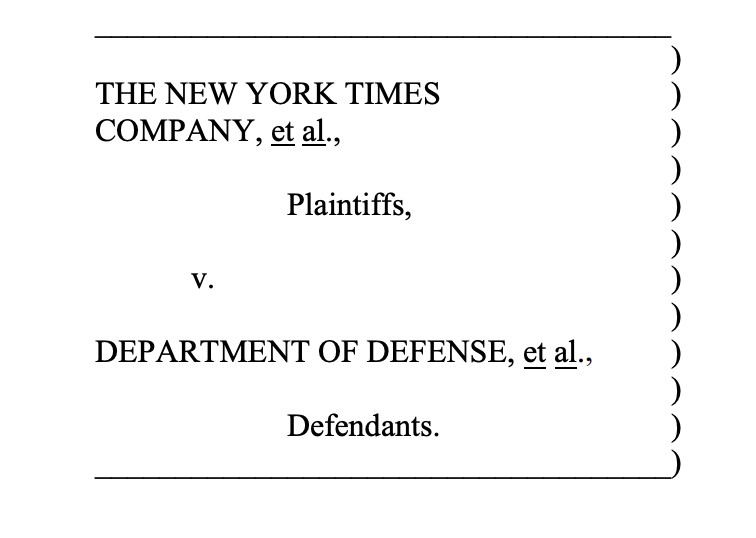
U.S. District Judge Paul L. Friedman of the United States District Court for the District of Columbia ruled last week that a Pentagon policy limiting press access violated the First Amendment, siding with journalists who argued the rules were designed in ways that could exclude or punish certain news organizations.
The policy in question required reporters to agree to restrictions on how they communicated with military personnel and gathered information, and several major outlets that declined to sign the agreement subsequently lost their Pentagon credentials. These organizations included The New York Times, The Washington Post, Reuters, Bloomberg News, the Associated Press, CNN, ABC News, CBS News, NBC News, NPR, Politico, the Financial Times, The Wall Street Journal, The Guardian, and even Fox News.
In striking down the policy, the court concluded that the government cannot impose press-access rules that effectively discriminate among journalists based on their reporting or editorial practices. The ruling ordered the Defense Department (notably referring to it as the Department of Defense rather than Department of War) to halt enforcement of the policy and restore access to affected reporters. The case will become a significant precedent in defining how far the government can go in regulating journalist access to federal facilities.
Further Reading (turn off your ad blocker to read)
3. Appeals court sanctions lawyers for AI-generated filings
The U.S. Court of Appeals for the Sixth Circuit imposed a $30,000 sanction on two attorneys after determining that a legal brief filed with the court contained numerous fictitious case citations that appeared to have been generated by artificial intelligence.
According to the court, the lawyers failed to verify the citations before submitting the document, resulting in references to cases that did not exist or were inaccurately described. The panel characterized the appeal as frivolous and warned that submitting unverified AI-generated material undermines both the judicial process and the credibility of the legal profession. The decision reflects a growing concern within the federal judiciary about the use of generative AI tools in litigation without proper oversight or fact-checking. Courts across the country have increasingly begun issuing warnings, sanctions, or new filing rules as they confront similar incidents involving fabricated legal authorities and/or decisions.
4. Appeals court allows third-country deportations (for now)
The United States Court of Appeals for the First Circuit temporarily allowed the federal government to resume expedited deportations of migrants to third countries, pausing a lower-court order that had blocked the policy. The contested program allows immigration authorities to remove migrants not only to their home countries but also to other nations willing to accept them, often with limited advance notice. So far, these destinations have included (or will include in the near future) El Salvador, Eswatini, Ghana, South Sudan, Liberia, Rwanda, Uganda, and Equatorial Guinea.
The US District Court for the District of Massachusetts previously halted the practice after finding that migrants were not given adequate opportunity to challenge their removal or raise fears about the country to which they might be sent (all of which have questionable human rights records). By lifting that injunction for the time being, the First Circuit permitted the government to continue implementing the policy while the case moves forward. Immigration advocates argue that the practice raises serious due-process concerns and could expose migrants to danger, while federal officials maintain that the authority is necessary to manage removal operations and international migration pressures, especially when migrants’ home countries refuse to accept them. The dispute is likely to continue through further appellate review.
Thank you for reading
We hope you enjoyed this week’s digest.
Have any questions? Leave us a comment, or send us a message!