
The Capitol Hill Reader 146: What Idolatry Can Do For You!
Your weekly government sampler

Hello Readers,
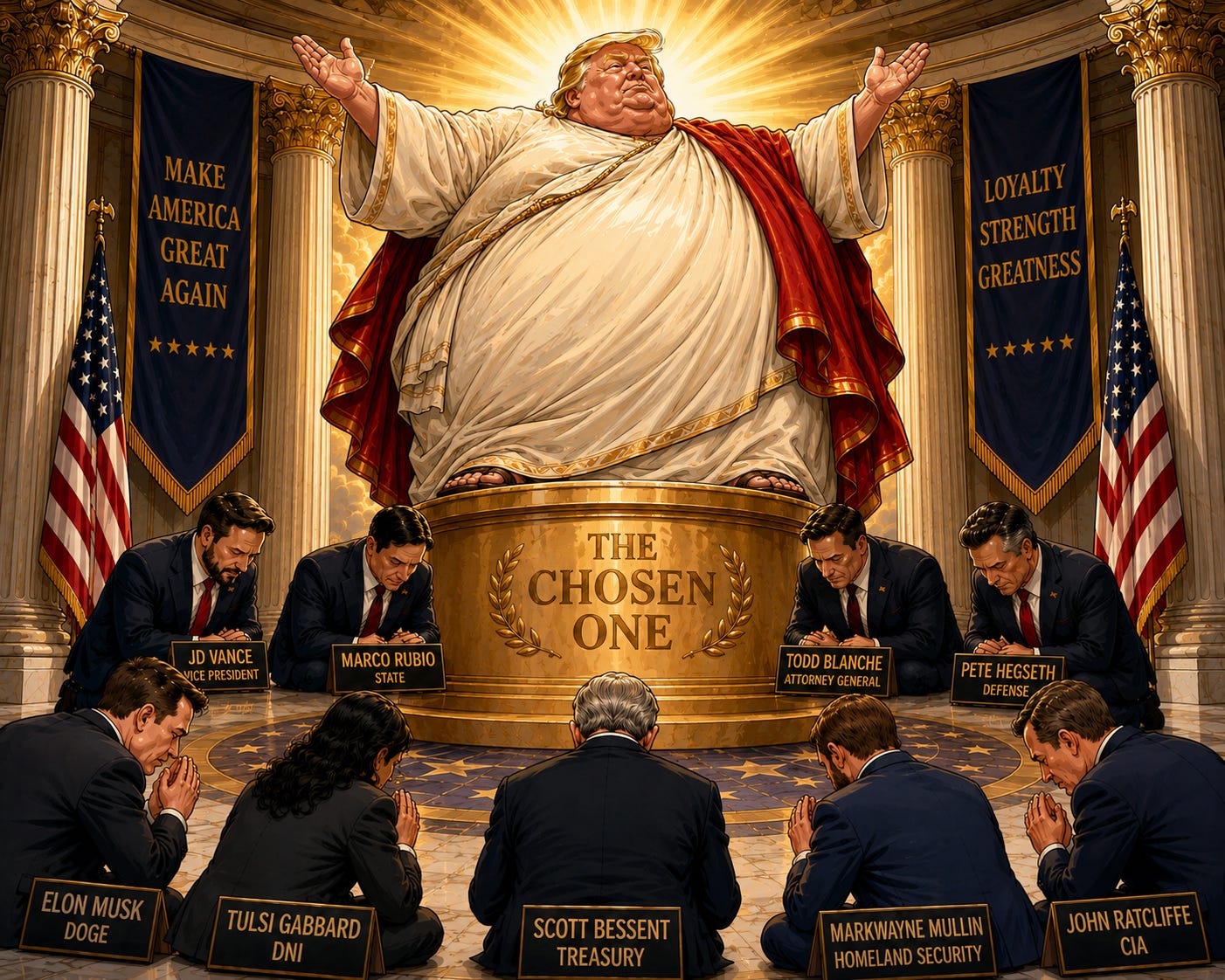
We have an interesting digest for you today. Not a lot of concrete action from Congress, but we do have some updates on the buildup towards appropriations and consideration for “the Clarity Act.” We also have some information on REDEDICATE 250, an evangelical event planned for May 17th on the National Mall, and the Great Golden Statue of our leader at his golf course in Coral, Florida. Finally, the 8th and 11th Circuits both give us interesting decisions regarding inmate and detainee rights, as well as on how they are treated by those in charge.
Let’s get started.
The Actions of the President
There were only four official additions to the presidential actions page on the White House website this past week, and all of these were announcements regarding various national celebration days. To read any of these, click the hyperlinks below:
1.) Military Spouse Day (May 7, 2026)
2.) Victory Day for World War 2 (May 7, 2026)
3.) NATIONAL PHYSICAL FITNESS AND SPORTS MONTH, 2026 (May 5, 2026)
4.) National Jewish Heritage Month (May 4, 2026)
Rededication 250
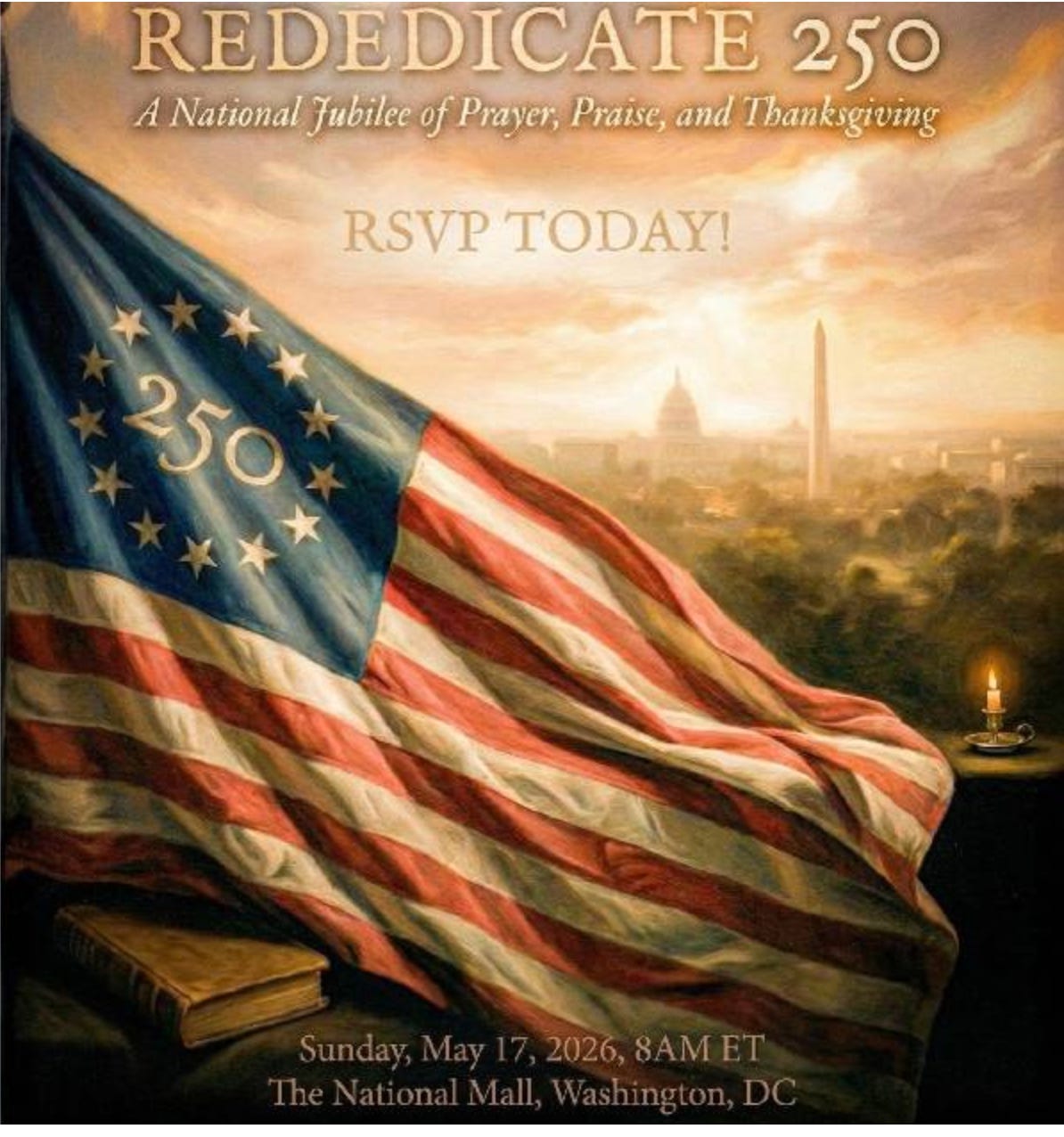
The picture above is the official flyer for the REDEDICATE 250 event taking place on the National Mall on May 17, 2026. This event, organized in part with the White House Task Force on Celebrating America’s 250th Birthday, is described as a massive Christian prayer and worship gathering on the National Mall ahead of the U.S. semiquincentennial.
As you may expect, this plan has drawn scrutiny over whether public resources are being used to promote and support a Christian evangelical service on federal property, though there is no public evidence available that shows Congress directly appropriating money specifically for REDEDICATE 250. Regardless, the lines between commemoration and private ideological advocacy (in this case, Christian belief) have definitely blurred here, especially because the gathering operates under a White House-linked initiative.
Major questions have focused on whether federal staffing, branding, security coordination, logistical support, and government-backed promotional infrastructure are indirectly subsidizing the event, but organizers argue that “religious expression” (Christian expression) has historically been part of American civic culture and note that large National Mall events routinely involve federal coordination and support.
This is indeed true on both counts, but Rededicate 250’s overtly Christian nationalist tone, combined with private high-dollar fundraising and official anniversary branding in line with a White House task force, all points to taxpayer-supported infrastructure benefiting a politically aligned religious movement.
The Golden Statue
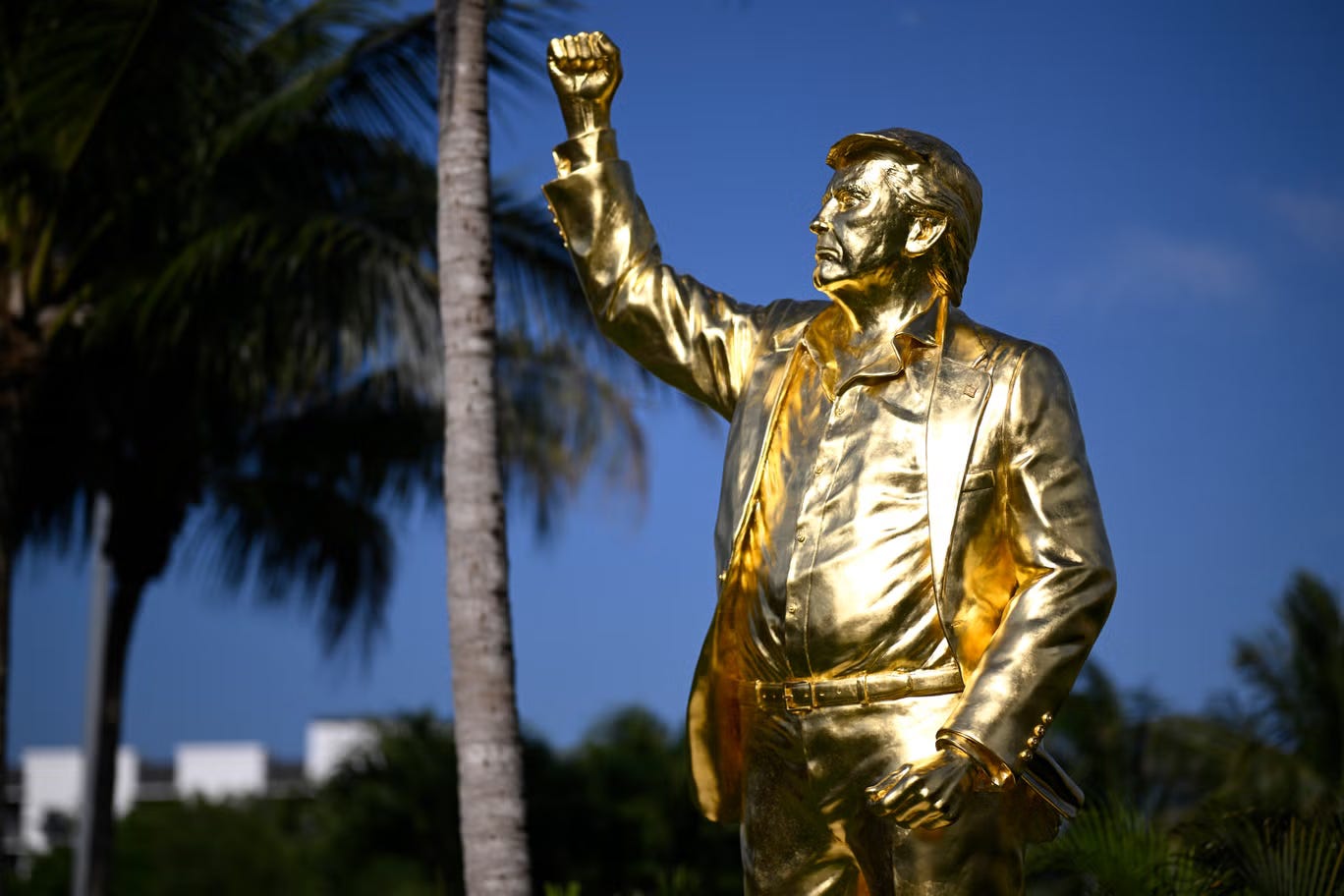
Also interesting this week: Trump supporters unveiled a massive bronze statue of the President himself at his golf course in Doral, Florida; apparently it’s 22 feet tall, coated in gold leaf, and has been deemed "the Don Colossus.” Attendees also “blessed” the statue in an hours long dedication ceremony, naturally presided over by an evangelical pastor. Per mainstream media, Trump himself called the ceremony to thank those in attendance.
So...yeah. There’s that. Anyway.
The Actions of Congress
No floor votes this week in either chamber, readers. That said, Congress had significant activity behind the scenes as lawmakers prepared for the next phase of budget and crypto legislation cage fights.
What does this mean?
Senate committees spent much of the week laying groundwork for upcoming reconciliation and appropriations battles tied to immigration enforcement, DHS funding, and broader Trump administration priorities for fiscal year 2027. One of the biggest developments came Friday, when the Senate Banking Committee formally scheduled consideration of the long-awaited “Clarity Act:” a cryptocurrency regulatory bill that would define when digital assets are treated as securities or commodities. The bill has become a major point of contention between crypto firms and the banking industry, particularly over provisions involving stablecoin rewards and interest-like payments that banks fear could pull deposits out of the traditional financial system (which they probably find pretty scary).
At the same time, congressional committees continued holding oversight and budget hearings with administration officials, including closed-door testimony from Commerce Secretary Howard Lutnick on his ties to disgraced pedophile Jeffrey Epstein; most notably, Lutnick previously stated that he cut ties with Epstein in 2005, but evidence shows communication continued well into the 2010s.
If you’ve got nothing to hide, Howard, why lie?
If the Capitol Hill Reader does not receive any new subscribers this weekend, the baby donkey in the photograph below will have to pause his Spotify subscription.

The more support we receive, the more time we can spend fighting for baby donkeys everywhere.
Subscribe today!
The Federal Courts
The Eighth Circuit Court of Appeals
Bolin v. Wilkins
Case Background and Lower Court Decision
In the early hours of April 1, 2020, officers at the Benton County Detention Center in Arkansas repeatedly used force against detainee Bradley Bolin during a series of confrontations that were extensively captured on jail surveillance footage. According to the opinion, officers initially brought Bolin into the booking lobby after his arrest on charges including resisting arrest, disorderly conduct, public intoxication, and felony battery.
The court described how deputies “crowded around Bolin and took him to the ground,” after which “four deputies completely covered Bolin’s body on the ground.” While restrained beneath multiple deputies, Deputy Joshua Loya twice used a taser on him. During that incident, officers can be heard ordering Bolin to stop resisting, warning him that he would be tased if he failed to comply. The opinion quotes one exchange directly:
“Deputy Loya: You don’t relax, you’re going to get tased. you understand that?”
“Bolin: Do it as many times as you f---ing want.”
The incidents escalated throughout the morning.
In one cell, Deputy Loya allegedly fired four pepper-spray projectiles at Bolin while he stood several feet away with his arms raised. Later, Deputy Landon Wilkins allegedly slammed Bolin to the floor after a hallway confrontation, during which “Bolin’s head struck the opposite wall.” The court further noted that Wilkins delivered “twelve closed fist strikes to Bolin’s head and torso” while Bolin was pinned on the ground. Another encounter in Pod E-103 involved officers “hitting, punching, and kicking Bolin” while he was obscured beneath surrounding deputies. Bolin later alleged lasting injuries including diminished vision, memory loss, chronic pain, and psychological trauma.
In their decision, the U.S. District Court for the District of Arkansas denied qualified immunity for several officers, concluding that factual disputes about whether the force used was reasonable should be resolved by a jury rather than dismissed before trial.
The 8th Circuit Ruling
In its ruling, the United States Court of Appeals for the Eighth Circuit partially affirmed and partially reversed the lower court.
The panel held that Deputy Loya was entitled to qualified immunity for his initial taser use in the booking lobby because the audio recording “blatantly contradict[ed]” the argument that Bolin was entirely compliant while officers attempted to restrain him. However, the court upheld the denial of qualified immunity for several later incidents, including the pepper-spray attack in Booking Cell 3, Deputy Wilkins’s hallway takedown, and Sergeant Franks’s later taser deployment in Pod E-103. The judges emphasized that clearly established law prohibits officers from using substantial force against detainees who are nonviolent, subdued, or not posing an immediate threat. The opinion specifically concluded that firing pepper-spray rounds at a detainee standing six feet away with his arms raised could plausibly constitute unconstitutional excessive force.
What Happens Next
The case will now return to the district court for further proceedings on the surviving claims. Because the Eighth Circuit allowed significant portions of the lawsuit to continue, the remaining defendants could face either settlement negotiations or a full jury trial. The surveillance footage will likely become the centerpiece of the litigation, especially since the appellate court repeatedly relied on the recordings in determining which facts were genuinely disputed and which were clearly established by the evidence.
Going forward, the case will center on whether the officers’ conduct was “objectively unreasonable” under the Due Process Clause standards that apply to pretrial detainees. Depending on how the litigation develops, the case could also draw broader attention to jail use-of-force policies and the limits of qualified immunity protections for correctional officers.
The Eleventh Circuit Court of Appeals
Alvarez v. Warden, Federal Detention Center Miami
Case Background and Lower Court Decision
Petitioners Fidencio Hernandez Alvarez and Ismael Cerro Perez, both Mexican nationals, had lived in the United States for years before their arrests — Hernandez Alvarez since 2019 and Cerro Perez since 2015. The opinion notes that Hernandez Alvarez “has no criminal history, and is the father of two children who are U.S. citizens,” while Cerro Perez “has three children who are American citizens as well” and had previously received only “minor traffic violations.”
Both men were arrested by immigration authorities after routine traffic stops in September 2025 and placed into removal proceedings as immigrants who entered the country “without inspection.” After being transferred through detention facilities including the Florida Soft-Sided Facility-South — referred to in the opinion as “Alligator Alcatraz” — both men were held without any opportunity for bond hearings under the Department of Homeland Security’s new interpretation of 8 U.S.C. § 1225(b)(2)(A).
The petitioners challenged that detention in federal court through habeas petitions, arguing that they should instead fall under 8 U.S.C. § 1226(a), which generally allows immigration judges to grant bond. The U.S. District Court for the Southern District of Florida agreed, concluding that although the men were technically “applicants for admission” under immigration law, they were not actively “seeking admission” at the time of their arrests and therefore were not subject to mandatory detention.
The court granted habeas relief and ordered bond hearings for both petitioners, after which each man was released from custody pending further proceedings.
The 11th Circuit Ruling
In a lengthy and detailed statutory interpretation decision, the Eleventh Circuit affirmed the district court’s ruling.
The panel rejected the federal government’s argument that all immigrants physically present in the country without lawful admission are automatically “seeking admission” and therefore subject to mandatory detention without bond. Instead, the court drew a distinction between being an “applicant for admission” (a technical immigration-law category) and actively “seeking admission,” which the court interpreted to require some affirmative attempt to obtain lawful entry into the United States. The judges emphasized that neither Hernandez Alvarez nor Cerro Perez was attempting to enter the country when arrested; rather, they had already been living in the interior of the United States for years and “were not seeking or pursuing any object, let alone ‘lawful entry.’”
The court also pushed back strongly against the government’s broader interpretation of the immigration statute, warning that it would effectively create a binary system in which immigrants must either pursue formal admission or “voluntarily self-deport.” The panel described that interpretation as incompatible with the broader structure of immigration law, which recognizes many lawful or semi-lawful statuses short of formal admission, including asylum, temporary protected status, and other humanitarian protections.
Ultimately, the Eleventh Circuit concluded that Congress had not clearly authorized mandatory no-bond detention for immigrants merely present in the country and that the government’s new interpretation stretched the statute beyond its text.
What Happens Next
The ruling represents a significant setback for the federal government’s effort to expand mandatory immigration detention to a much broader class of immigrants already living inside the United States.
Because the Eleventh Circuit aligned itself against decisions from some other federal appellate courts, the case deepens an emerging circuit split over the meaning of § 1225(b)(2)(A), increasing the likelihood that the issue could eventually reach the Supreme Court. In the meantime, immigrants within the Eleventh Circuit (Alabama, Georgia, and Florida) who are similarly situated may now have stronger grounds to seek bond hearings while their removal cases proceed, though the broader legal battle over immigration detention authority is almost certainly far from over.
Thank You
We hope you enjoyed this edition of the Capitol Hill Reader. We have an article in the works on the upcoming changes to FEMA and how it could affect you in case of disaster. Stay tuned.
Thank you for the update
In the White House proclamation titled, "VICTORY DAY FOR WORLD WAR II, 2026", it states:
"Let us remember them, and the millions of innocent souls who endured horrendous atrocities, and lost their lives, at the hands of national socialism."
Only Trump's White House could be so stupid or arrogant to proclaim that Nazi's were actually Socialists.